
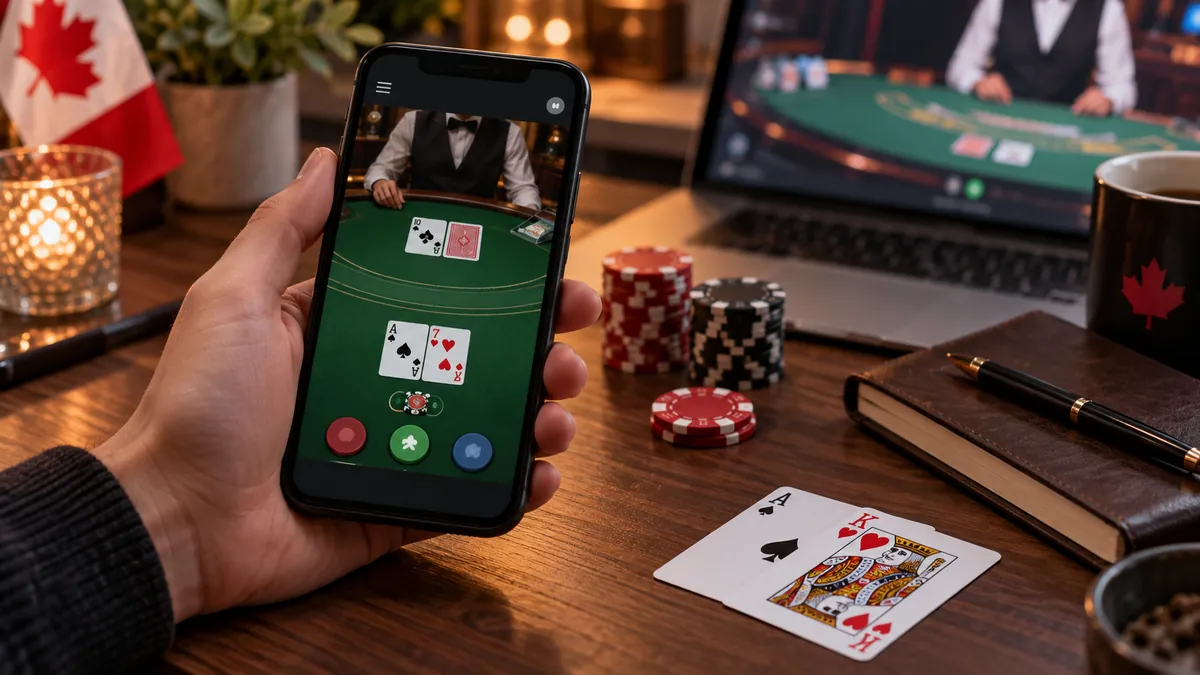
Rules that matter before you sit down
| Rule | Player-friendly direction | Why it matters |
|---|---|---|
| Blackjack payout | 3:2 rather than 6:5 | The payout difference can materially change the house edge |
| Soft 17 | Dealer stands | More favourable than a dealer required to hit |
| Doubling | Fewer restrictions | More flexibility for basic-strategy decisions |
| Surrender | Available | Adds a way to reduce losses on weak starting hands |
The Basic Goal and Rules of Blackjack
Blackjack's objective is simple: get your hand's total value closer to 21 than the dealer's hand, without going over. Card values are straightforward - number cards count at face value, face cards (jack, queen, king) count as 10, and aces count as either 1 or 11, whichever benefits your hand more at any given moment.
Each round begins with two cards dealt to the player and two to the dealer, with one dealer card typically left face-down (the "hole card") until the round concludes. From there, players choose from a set of possible actions:
- Hit - take an additional card.
- Stand - keep your current hand and take no further cards.
- Double down - double your original bet in exchange for exactly one more card, then automatically stand.
- Split - if your first two cards share the same value, split them into two separate hands, each requiring its own additional bet equal to your original wager.
- Surrender (where offered) - forfeit half your bet and end the hand immediately, typically only available as your first decision.

A "blackjack" - an ace plus a 10-value card as your first two cards - typically pays out at 3:2 (or, at some tables, a less favourable 6:5) rather than the standard 1:1 payout on other winning hands, making it worth understanding your table's specific payout structure before you sit down.
Basic Strategy: Why It Matters More Than Anything Else
Basic strategy is a mathematically derived set of decisions - hit, stand, double, or split - for every possible combination of your hand and the dealer's visible up-card. It's been calculated to minimize the house edge as much as mathematically possible without card counting, and following it consistently is, by a wide margin, the single most impactful thing a blackjack player can do to improve their results.
Playing purely on instinct rather than basic strategy typically costs players an additional 1.5% to 2% or more in house edge - a significant gap in a game that can otherwise offer under 1% when played correctly. The good news is that basic strategy doesn't require memorizing anything particularly complex; it comes down to a relatively small set of situational rules that become second nature with a bit of practice.
Key Basic Strategy Principles
Always split aces and eights. Splitting aces gives you two chances at a blackjack-value starting hand, while an eight-and-eight (a 16) is one of the worst possible hands to keep intact - splitting it into two separate hands is almost always better than standing or hitting on a hard 16.
Never split tens or fives. A pair of 10-value cards is already a strong 20 - breaking it into two separate hands throws away a near-guaranteed win for two uncertain ones. A pair of fives is better played as a hard 10, typically by doubling down against most dealer up-cards.
Double down on strong totals against weak dealer cards. A hard 11 against almost any dealer up-card, or a hard 10 against a dealer showing 2 through 9, are classic doubling opportunities where the odds favour increasing your bet.
Stand on hard totals of 17 or higher, always. The risk of busting outweighs any potential benefit of hitting once you're at 17 or above with no ace to count as 1.
Hit on hard totals of 11 or lower, always. There's no risk of busting at 11 or under, so hitting is always correct in this range regardless of the dealer's up-card.
The dealer's up-card should heavily influence your decisions on marginal hands. A hard 12 through 16 is where strategy gets the most nuanced - generally, stand against a dealer showing a weak card (2 through 6, where the dealer has a higher bust probability) and hit against a dealer showing a strong card (7 through ace).
A full basic strategy chart covers every possible hand combination in more precise detail than a general overview can capture - printable and app-based charts are widely available, and many online casinos even allow a strategy chart to be referenced during real-money play, since basic strategy isn't considered card counting or cheating in any way.
Popular Blackjack Variants
Classic (American) Blackjack typically uses six to eight decks, offers a dealer hole card dealt face-down from the start, and allows late surrender at many tables.
European Blackjack usually uses fewer decks (often two) and deals the dealer's second card only after players complete their actions - a structural difference that changes optimal strategy slightly, since players can't see a dealer bust possibility as early.
Blackjack Switch deals two hands to each player simultaneously, with the option to swap the second card between the two hands to build stronger combinations - a unique twist that comes with its own adjusted payout structure, typically a reduced blackjack payout, to offset the added player advantage.
Live Dealer Blackjack streams a real dealer from a studio in real time, combining the social, authentic feel of a physical casino table with the convenience of online play. Live blackjack typically follows standard rules closely, with betting handled through an on-screen interface rather than physical chips.
Multi-Hand Blackjack allows a single player to play several hands simultaneously against the same dealer, which speeds up overall gameplay and can be appealing to more experienced players comfortable managing several hands' worth of decisions at once.
Perfect Pairs and side bets, available at many tables, offer additional wagers on specific outcomes like your first two cards forming a pair. These side bets typically carry a significantly higher house edge than the main blackjack game and are worth approaching with that in mind rather than as a core part of your strategy.
Rule Variations That Affect the House Edge
Not all blackjack tables are created equal, and small rule differences can meaningfully shift the house edge in either direction. Worth checking before you commit to a table:
- Blackjack payout: 3:2 vs. 6:5. A 3:2 payout is significantly better for players; 6:5 tables increase the house edge substantially and are generally worth avoiding when a 3:2 alternative is available.
- Number of decks. Fewer decks generally favour the player slightly, all else being equal, though the effect is smaller than most other rule variations.
- Dealer stands or hits on soft 17. A dealer required to stand on soft 17 (a hand like ace-6) is more favourable to players than one required to hit, since hitting gives the dealer another chance to improve a marginal hand.
- Doubling restrictions. Some tables only allow doubling on specific totals (like 9, 10, or 11) rather than any two-card hand, which reduces player flexibility and slightly increases the house edge.
- Surrender availability. Tables offering late surrender give players an additional tool to minimize losses on genuinely weak hands, improving overall player return.
Checking a table's specific rules - usually available in the game's information menu - before playing is a quick way to make sure you're not sitting down at a table with a meaningfully worse house edge than necessary.
Common Blackjack Mistakes to Avoid
Taking insurance. Insurance is a side bet offered when the dealer shows an ace, paying out if the dealer has blackjack. Despite the appealing framing, insurance carries a notably poor house edge for the player in the vast majority of situations and is generally not recommended as part of a sound basic strategy approach.
Standing on soft hands too early. A soft hand (one containing an ace counted as 11) has more flexibility than players often give it credit for - a soft 18, for instance, is often better played by hitting or doubling against a strong dealer up-card rather than automatically standing.
Ignoring the dealer's up-card. Playing your hand the same way regardless of what the dealer is showing throws away one of the most important pieces of information in the entire game.
Chasing losses by increasing bet size erratically. Basic strategy optimizes your odds on any individual hand, but it doesn't change the underlying house edge - no betting pattern can turn a losing streak around through sheer bet-size escalation.
Playing 6:5 tables when 3:2 tables are available. The blackjack payout difference alone can swing the house edge by well over a percentage point - always check this before choosing a table.
Card Counting: Reality vs. Myth
Card counting has an outsized reputation in popular culture, but it's worth understanding what it actually is and isn't. In principle, card counting tracks the ratio of high to low cards remaining in the shoe to estimate when the remaining deck favours the player, adjusting bet size accordingly. In practice, it's largely a land-based casino consideration - most online blackjack games, particularly RNG-based ones, reshuffle after every hand or use continuous shuffling machines in live dealer settings, which eliminates the deck-composition tracking that card counting depends on entirely.
For online Canadian players, basic strategy - not card counting - remains the relevant, genuinely useful skill to develop.
Bankroll Management for Blackjack
Blackjack's relatively low house edge when played correctly makes disciplined bankroll management particularly rewarding, since your money tends to last longer than at higher-house-edge games. A few practical guidelines:
- Size your bets so a realistic losing streak doesn't wipe out your session budget. Blackjack can produce longer losing streaks than intuition suggests, even with correct strategy.
- Avoid progressive betting systems that claim to "beat" blackjack mathematically. No betting pattern changes the underlying house edge on any individual hand - money management systems affect variance, not expected value.
- Set a win goal as well as a loss limit. Deciding in advance when you'll walk away after a good session helps lock in gains rather than giving them back to variance.
Our Responsible Gambling page covers deposit limits, time-outs, and other tools every licensed Canadian operator provides to help you stick to your plan.
Blackjack Bonuses: What to Watch For
Casino welcome bonuses are typically weighted heavily toward slots, and blackjack - along with most table games - often contributes at a significantly reduced rate toward wagering requirements, sometimes as low as 5-20% of the wager counting toward clearing the bonus. Some bonuses exclude blackjack from contributing at all. If you're primarily a blackjack player, it's worth checking a bonus's specific game contribution terms before assuming it's genuinely useful for your preferred game, rather than being drawn in by an attractive headline percentage aimed at slot players. Our Payment Methods and Bonus Guide covers how to evaluate these terms more broadly.
A Brief History of Blackjack
Blackjack traces its roots to French gambling houses in the 1700s, where a game called "Vingt-et-Un" ("twenty-one") first established the core mechanic of building a hand as close to a target number as possible without exceeding it. The game evolved considerably as it spread internationally, eventually landing in American casinos in the early 1900s, where the name "blackjack" emerged from a short-lived promotional payout bonus for a hand containing the ace of spades and a black jack specifically - a bonus that disappeared long ago, but the name stuck permanently.
The game's modern strategic depth owes a great deal to mathematical analysis conducted in the mid-20th century, when researchers first used computer simulations to calculate the mathematically optimal decision for every possible player-dealer hand combination - the foundation of the basic strategy still used today. That research also gave rise to card counting techniques, which, while largely irrelevant to online play due to frequent reshuffling, cemented blackjack's reputation as a game where genuine skill and mathematical analysis can meaningfully improve a player's results compared to games of pure chance.
Blackjack Etiquette at Live Dealer Tables
Live dealer blackjack, which streams a real dealer from a studio, follows a few informal conventions worth knowing, particularly if you're used to purely digital RNG tables. Hand signals - tapping the table for a hit or waving a hand over your cards to stand - are traditional at physical tables and are sometimes still used or referenced in live dealer interfaces, though most online live dealer platforms rely primarily on clear on-screen button controls rather than requiring players to master physical signals. Chat functionality at live tables is typically welcomed for friendly interaction with the dealer and other players, though excessive chat can sometimes slow down the pace of play for the whole table, particularly during busier sessions.
Blackjack Glossary
a hand with no ace, or one where any ace must count as 1 to avoid busting.
a hand containing an ace counted as 11, giving the hand extra flexibility since the ace can adjust to 1 if needed.
exceeding a total of 21, resulting in an automatic loss regardless of the dealer's subsequent hand.
a tie between player and dealer, resulting in the original bet being returned rather than won or lost.
the dealer's face-down card, revealed only after all players complete their actions.
the device holding multiple shuffled decks of cards used for dealing in multi-deck blackjack games.
a two-card hand totalling 21 (an ace plus a 10-value card), typically paying out at an enhanced rate compared to standard wins.
an option offered to a player holding a natural when the dealer shows an ace, allowing an immediate 1:1 payout rather than risking the standard 3:2 blackjack payout against the possibility of a dealer push.
Blackjack Tournaments
Beyond standard cash-table play, some Canadian-facing operators run blackjack tournaments, where players compete against each other - not just the dealer - across a series of hands, typically ranked by chip count at the end of a set number of rounds. Tournament blackjack introduces a genuinely different strategic layer beyond standard basic strategy, since your optimal decisions can shift based on your chip position relative to other competitors - for example, a player trailing late in a tournament may deliberately deviate from basic strategy to take on more variance in pursuit of a larger stack, while a chip leader may play more conservatively to protect their position. This adds a genuinely interesting wrinkle for experienced players looking for something beyond standard basic-strategy cash play.
Insurance and Side Bets: A Closer Look
Beyond the core insurance bet already covered above, many blackjack tables offer additional side bets - Perfect Pairs (wagering your first two cards form a pair), 21+3 (combining your first two cards with the dealer's up-card into a poker-style hand), and Lucky Ladies (wagering your first two cards total 20) among the most common. These side bets are wagered and resolved independently of your main blackjack hand, meaning you can win a side bet while losing your main hand, or vice versa. Nearly all of them carry a significantly higher house edge than the main game played with correct basic strategy - often in the 5% to 25% range depending on the specific side bet - making them best treated as an occasional, deliberately small novelty wager rather than a core part of a value-focused blackjack strategy.
Building a Blackjack Practice Routine
Because basic strategy is a fixed, learnable skill rather than an intuition-based one, deliberate practice pays off more directly in blackjack than in almost any other casino game. Many players find it useful to practice basic strategy decisions using a printed chart or app in low-stakes or free-play settings before committing to real-money sessions, repeating the process until the correct decision for common hand-and-up-card combinations becomes automatic rather than requiring active chart-checking mid-hand. This kind of deliberate practice - treating basic strategy as a skill to be drilled rather than a chart to be referenced indefinitely - is exactly what separates players who consistently play close to the game's mathematically optimal edge from those who play by instinct and unknowingly give back a meaningful percentage in the process.

Frequently Asked Questions
Typically between 0.5% and 1%, depending on the specific table rules - among the lowest house edges of any common casino game.
Card counting itself isn't illegal, but it's largely ineffective against online blackjack due to frequent reshuffling, and land-based casinos retain the right to refuse service to suspected counters.
Generally no - like insurance, even money offers tends to carry a house edge that basic strategy recommends declining in most standard situations.
A soft hand includes an ace counted as 11 (like ace-6, a "soft 17"); a hard hand either has no ace or counts any ace as 1. Soft hands have more flexibility since the ace can adjust if you draw a card that would otherwise bust the hand.
Yes, at licensed operators - live dealer games use real cards and dealers, typically with continuous shuffling machines, streamed under regulatory oversight and monitoring equivalent to standard land-based casino requirements.
Ready to Play?
Blackjack rewards the effort you put into learning it more than almost any other casino game, and a solid grasp of basic strategy is genuinely achievable with a bit of practice. Compare licensed Canadian operators on our homepage, confirm what's legal in your province, and check out our Online Poker Guide or Online Roulette Guide if you're looking to round out your table game repertoire.
This guide is for informational purposes only. Gambling involves financial risk; play only with money you can afford to lose. If gambling is affecting you or someone you know, visit our Responsible Gambling page.
Keep the game in perspective
Set your budget before you play, use the player-protection tools offered by licensed operators, and treat gambling as entertainment rather than a financial strategy.
Responsible Gambling Guide →